

What Is Alpha Gal Syndrome? (And Why Your Travel Plans Just Got More Complicated)
If you are reading this at eleven at night with a plate of something you now regret and a search history that includes the phrase “why do I feel like death after eating steak,” I want you to know two things right away. You are not imagining it. And you are very much not the first. Alpha Gal Syndrome is real, it is more common than almost anyone realizes, and it is one of the genuinely strange conditions in modern medicine. It took me years and an embarrassing number of doctor visits to get an answer. This is the explanation I wish someone had handed me on day one.
The (weirdly) good news: Alpha Gal cases are on the rise and the medical community is starting to pay attention. More research is coming out every month and the landscape is changing.
Get my free, five page Alpha Gal and Celiac Travel Starter Guide here.
The short answer.
Alpha Gal Syndrome, usually shortened to AGS, is an allergy to a sugar molecule called galactose-alpha-1,3-galactose. Alpha-gal, for people who would like to keep their tongue. That molecule lives in the tissue of most mammals. Cows, pigs, sheep, deer, goats, rabbits. Humans do not produce it, and neither do other Old World primates, which is exactly why our immune systems are capable of deciding it is an enemy. Here is the part that surprises everyone: you do not develop this allergy by eating too much red meat. You develop it from a tick bite. Wild, right? Its’ true and it’s really not any fun.
The tick part.
In the United States, the main culprit is the Lone Star Tick, Amblyomma americanum, named for the single white dot on the female’s back. It is an aggressive biter and it is one of the few American ticks that will bite humans even in its tiny larval stage, when it is roughly the size of a poppy seed (in other words, absolutely tiny). Alpha-gal is present in tick saliva. When the tick bites, it delivers that molecule directly into your bloodstream in a context your immune system reads as a threat, and your body starts building IgE antibodies against it. Then one ordinary evening you eat a burger, your immune system recognizes the same molecule it was trained to attack, and it responds accordingly.
According to the CDC, the Lone Star Tick is widely distributed across the Northeast, South, and Midwest. Its range has pushed north over the last several decades, tracking the recovery of white-tailed deer populations since the 1940s along with land use changes and warming. The one that got me was most likely in a wooded part of Iowa but there’s a chance it came from a backpacking trip to Arkansas.
It is not only the lone star tick, and it is not only America.
In March 2025, the CDC published a case in Emerging Infectious Diseases documenting Alpha Gal Syndrome in a Maine woman after a confirmed Blacklegged Tick bite. Statewide screening turned up 57 Maine residents with elevated Alpha-Gal antibodies, most of them in coastal counties. Maine sits well outside established lone star territory.
Internationally, the Castor Bean tick in Europe and the Paralysis tick in Australia are both confirmed vectors, with additional species suspected in Japan, Korea, Brazil, Central America, and southern Africa. So, if you are wondering whether you can pick this up on a trip: yes. Anywhere with ticks and mammals is, in theory, a place this can start.
One more timing detail that trips people up. The gap between the tick bite and your first reaction is usually one to four months, but it can be a few weeks or it can be years. Most people never identify the bite that did it. I certainly did not, until long after the fact. It was actually a year before I started noticing the reaction, and another couple of years before I figured out the Alpha Gal diagnosis.
The delay is the cruelest part.
Nearly every other food allergy announces itself within minutes. Peanut, shellfish, egg. You eat the offending food and immediately start reacting, the connection is obvious. Alpha Gal doesn’t work that way and it’s a bit infuriating. The CDC puts the typical window at two to six hours after eating. The wider clinical literature describes a range closer to two to ten hours, with the occasional person reacting immediately.
I react immediately to any cross contamination with pork, I mean ANY cross contamination. Even the smell of cooking bacon is enough to trigger a reaction. Luckily for me, it has not reached an anaphylactic reaction stage.
The reason is genuinely interesting. Most allergens are proteins, which absorb quickly. Alpha-gal rides mostly on fat molecules. Your body has to digest those fats, package them into particles called chylomicrons, and route them through the lymphatic system before they reach your bloodstream. That process can take up to about four hours. Which means the practical experience of this condition is that you eat dinner, go to bed, and wake at two in the morning feeling like you are dying. And when you try to work out what happened, you think about the questionable side salad, or a stomach bug, or stress. The one thing you do not suspect is the steak you ate five hours earlier.
What it actually feels like.
The textbook list: hives, itching, swelling of the lips or throat, stomach cramping, nausea, vomiting, diarrhea, and in serious cases anaphylaxis. But here is what the textbook underplays. There is an entire population of people whose Alpha Gal shows up as gastrointestinal symptoms and nothing else. (Hi, it’s me, plus flu like symptoms with a fever and chills). No hives. No swelling. Just abdominal pain, nausea, and digestive chaos that gets filed as IBS for years. In one southeastern gastroenterology clinic, close to a third of patients referred for unexplained GI symptoms turned out to have Alpha-Gal antibodies.
If that is you, you have probably been told it is stress. It might not be stress. Also, hi again, that was my story.
On severity: this can absolutely be life threatening. During supervised food challenges in a clinical setting, somewhere between fifteen and twenty percent of AGS patients required epinephrine, emergency transport, or both. Emergency medicine literature now describes Alpha Gal as an increasingly common cause of anaphylaxis that presents without an obvious trigger.
Please consult with your doctor and if you have been diagnosed with Alpha Gal, also ask your doctor or allergist about an epinephrine pen.
How many people actually have this.
This is where I want to be careful, because the numbers get mangled constantly, including by outlets that should know better. In 2023 the CDC estimated that somewhere between 96,000 and 450,000 Americans might have been affected since 2010. You will see 450,000 quoted everywhere as if it were a firm count. It is the top of a very wide range, and it is cumulative over more than a decade.
Then in July 2026 the CDC published something genuinely new: a survey of blood donors across ten states. The share of donors carrying alpha-gal antibodies was startling.
- Arkansas: 31.2 percent
- Missouri: 26.0 percent
- Virginia: 22.8 percent
- Kentucky: 22.7 percent
- Tennessee: 21.5 percent
- Washington state, at the other end: 1.1 percent
Before you panic about that Arkansas number, and I say this as someone who lives in the region: carrying the antibody is not the same as having the disease. Only somewhere around five to nine percent of people with detectable Alpha-Gal antibodies actually develop a clinical allergy. The CDC said so directly in that same report, warning that treating a positive test as a diagnosis leads to over diagnosis and unnecessary dietary restriction. The study also confirmed something the patient community already suspected. This is a rural exposure condition. For every tenfold increase in county population density, the odds of testing positive dropped by roughly thirty percent. Ticks live where the deer and the woods are. Also known as, all of the places I like to explore and play. Awesome.
Why your doctor may have never heard of it.
In 2022 the CDC surveyed 1,500 American healthcare providers. Forty-two percent had never heard of Alpha Gal Syndrome. Of those who had, nearly half did not know which test to order. Only five percent answered three basic questions about it correctly. There is a 2017 study of 28 patients that I think about often. Between them they logged over a hundred medical encounters before anyone landed on the right answer, including 28 emergency room visits. Forty-three percent found their way to the correct specialist on their own, without a referral. For most of them, the average time to diagnosis was just over seven years. It was 7 years for me as well.
It is a small study and awareness has improved since. But if you have been dismissed, misfiled, or told it was anxiety, you are in extremely well-documented company. I got the classic version myself, which I wrote about in my own diagnosis story. It involved a nurse practitioner, a gallbladder I did not need removed, and a phrase I will never forget.
How it is diagnosed.
There is a specific blood test: alpha-gal specific IgE. You can ask for it by name. Labcorp lists it as test code 650001 and Quest as 10554. Bring the code with you if you have to. Two things the number will not tell you. First, the size of your antibody level does not predict how badly you will react. A high number does not mean worse reactions, and a modest number does not mean you are safe.Second, and more importantly, a positive test on its own is not a diagnosis. You need a positive test and a clinical history that fits. As of 2026 there is also research arguing against screening people who have no symptoms at all, because a nonspecific positive result generates fear and dietary restriction without helping anyone.
So: if you have symptoms, push hard for the test. If you feel fine, do not go looking for a reason to worry. Worth knowing: roughly two percent of people with genuine Alpha Gal Syndrome test negative anyway. A negative result with a textbook history is worth a second opinion from an allergist who knows this condition. Hi, it’s me. My test was negative at first, but the very small of bacon sent me running for the bathroom.
What you actually have to avoid.
This is the part where the internet will terrify you, so let me separate what is established from what is not.
Off limits for essentially everyone.
- Mammalian meat: beef, pork, lamb, venison, goat, rabbit, bison
- Organ meats, which carry even more alpha-gal than muscle meat
- Mammalian fat: lard, tallow, suet. This hides in tortillas, refried beans, pastries, and anything deep fried in the wrong oil
- Bone broth, beef or pork stock, bouillon, most gravy
- Sausage casings, which are often mammalian collagen even on a chicken or turkey sausage
- Blood sausage, black pudding, and meat extracts
That fat point deserves emphasis, because it is the one that gets travelers. A restaurant will tell you the dish has no meat in it and be completely sincere, because nobody thinks of the lard in the tortilla or the beef tallow in the fryer as an ingredient. This has gotten me before and while it wasn’t life threatening, it made the rest of a travel day pretty miserable.
I am also careful to only use marine collagen and plant based protein powder.
Genuinely varies person to person.
This is the category people get wrong, usually by assuming the worst case applies to them.
- Dairy. Reported reaction rates run anywhere from ten to fifty percent of AGS patients, and high fat dairy is the usual offender. Ice cream is the classic trigger. A large share of people with AGS drink milk and eat cheese without trouble.
- Gelatin in food. Under ten percent of patients react to it. Injectable and medical gelatin is a different and more serious story.
- Trace byproducts like mono and diglycerides, or vitamin D3 derived from lanolin. Roughly one percent or fewer.
- Magnesium stearate, stearic acid, and glycerin. Largely theoretical. There is very little data, and most patients tolerate magnesium stearate without issue. The internet drastically overstates this one.
I personally know THREE people in my community that also have Alpha Ga. Guess what? We all react differently. I can tolerate a bit of butter, my friend cannot. My friend cannot handle the dairy smells in an ice cream shop or her throat will start to close up, but she can cook bacon. Bacon is banned from my house unless my husband cooks it outside, because I’m that sensitive to the smell. Dairy smells don’t bother me, even though I also can’t do dairy. That’s part of why this disease is so difficult.
The genuinely unresolved one: carrageenan.
Carrageenan is seaweed derived, so it contains no mammal products. A 2015 paper argued it carries the Alpha-Gal molecule anyway. Later laboratory testing failed to confirm that cross-reactivity. Roughly one to two percent of patients report reacting to it, and research was still active as recently as 2025.
Neither “carrageenan is dangerous” nor “carrageenan is a myth” is currently supportable. If you react to it, take that seriously. If you do not, there is no evidence-based reason to hunt it out of every label. I react to it and keep it out of my diet.
Two odd ones worth knowing.
Flounder roe contains Alpha-Gal. In one study, three quarters of people who reacted to red meat also reacted to it. No other fish roe has shown the same thing. And “natural flavors” on an American label can be derived from beef or pork, with no requirement that the manufacturer tell you. That is a real gap and there is no clever workaround beyond calling the company. I’ve never tried it and don’t plan to, so take that for what it’s worth.
If you want the long version of this, sorted by where you actually run into it rather than by how alarming it sounds, I wrote a separate post on Alpha Gal hidden ingredients.
The part nobody warns travelers about.
If you take one thing from this post that you will not find in most Alpha Gal explainers, make it this one.
A number of vaccines contain gelatin. That list includes MMR, varicella, and live intranasal influenza. It also includes yellow fever, rabies, and oral typhoid, which are precisely the vaccines you get before international travel. This needs to be a conversation with your travel clinic before the appointment. Say the words “I have Alpha Gal Syndrome and I need to know whether this vaccine contains gelatin” and give them time to check.
The same principle applies to medication generally. Gelatin capsules are common and frequently not disclosed on the label, and that gets harder in a country where you cannot read the packaging. On the emergency care side, heparin, equine antivenins, gelatin-based plasma expanders, and bioprosthetic heart valves are all mammalian derived. Heparin is tolerated by the overwhelming majority of AGS patients, but it is worth carrying documentation of your diagnosis when you travel so nobody has to guess.
Grills, smoke, and shared surfaces.
Alpha-gal is heat stable. Cooking does not destroy it. A grill that just cooked burgers is not neutralized by the flame, which is why shared grill surfaces and shared fryer oil are legitimate questions to ask, not fussy ones. Shared surfaces are a huge problem for me. I regualrly (politely) ask if my fish or shrimp can be cooked on a separate part of the grill that has been cleaned.
The airborne question is murkier and I want to represent it honestly. Many patients report reacting to the smoke from cooking mammalian meat, and expert estimates put that group somewhere between ten and thirty percent. But Dr. Scott Commins, who is about as close to an authority on this condition as exists, has said plainly that no blinded challenge study has been published documenting the airborne route. The proposed mechanism is plausible: fat aerosolizes, alpha-gal survives heat, you inhale it, and for me, that can make me very sick.
So: widely reported by patients, not yet formally proven. If it happens to you, it is not in your head. Notably, patients who describe airborne reactions describe them starting within minutes, which inverts the usual delay and makes them much easier to identify. This holds true for myself.
Why this changes travel specifically.
Everything above adds up to a condition that is uniquely awkward for people who leave home. The delay means you can eat lunch in one city and react in another. Mid-flight. Mid-drive. At two in the morning in a hotel room in a country where you do not speak the language and cannot read the pharmacy signs. If you carry epinephrine, make sure it’s not in a checked bag and not in the overhead bin.
No airline has an Alpha-Gal meal code. The special meal categories that exist, vegetarian and gluten free and low fat, do not map onto this condition. Vegetarian is the closest and it is still a gamble on dairy. I am telling you all of this not to talk you out of going. I am telling you because I have been navigating exactly this for over a decade and I still go. You just have to get good at asking a very specific set of questions (please ask nicely), and that is a learnable skill rather than a personality trait.
What I want you to do next.
- If you have symptoms that fit, ask for the Alpha-Gal specific IgE test by name. Write the test code down before the appointment.
- Start a food and symptom log, and record times, not just meals. The gap between the two is the whole diagnostic clue.
- Take tick prevention seriously starting today, because it determines whether this improves or gets worse.
- Find an allergist who has actually seen this condition. If your first provider dismisses you, that is information about the provider, not about your body.
- Do not restrict your entire diet based on a website. Including this one. Work out your own triggers with medical guidance rather than adopting the internet worst case.
Getting this diagnosis feels like the end of something. Every restaurant looks hostile, every menu looks like a minefield, and every person who says “so you can just eat chicken, right?” makes you want to scream. Ten years in, I can tell you it is the start of something instead. You get sharper. You ask better questions. You find the chefs and the hotels and the whole cities that get it right, and when you finally sit down to a meal that somebody made safe for you on purpose, it tastes better than it ever did before.
A diagnosis is not a destination. It is where the real adventure starts, even if it’s a little different than you expected.
I am not a doctor. I have lived with Celiac Disease and Alpha Gal Syndrome for over a decade, which makes me experienced, not qualified to diagnose or treat you. Everything here is drawn from published research and my own experience. Please take your questions to a qualified allergist.
Get my free, five page Alpha Gal and Celiac Travel Starter Guide here.
Keep reading.
New here? Start with my story, or come find me on Instagram at @alphaceliacgal, where I post the safe finds in real time.
About the author.
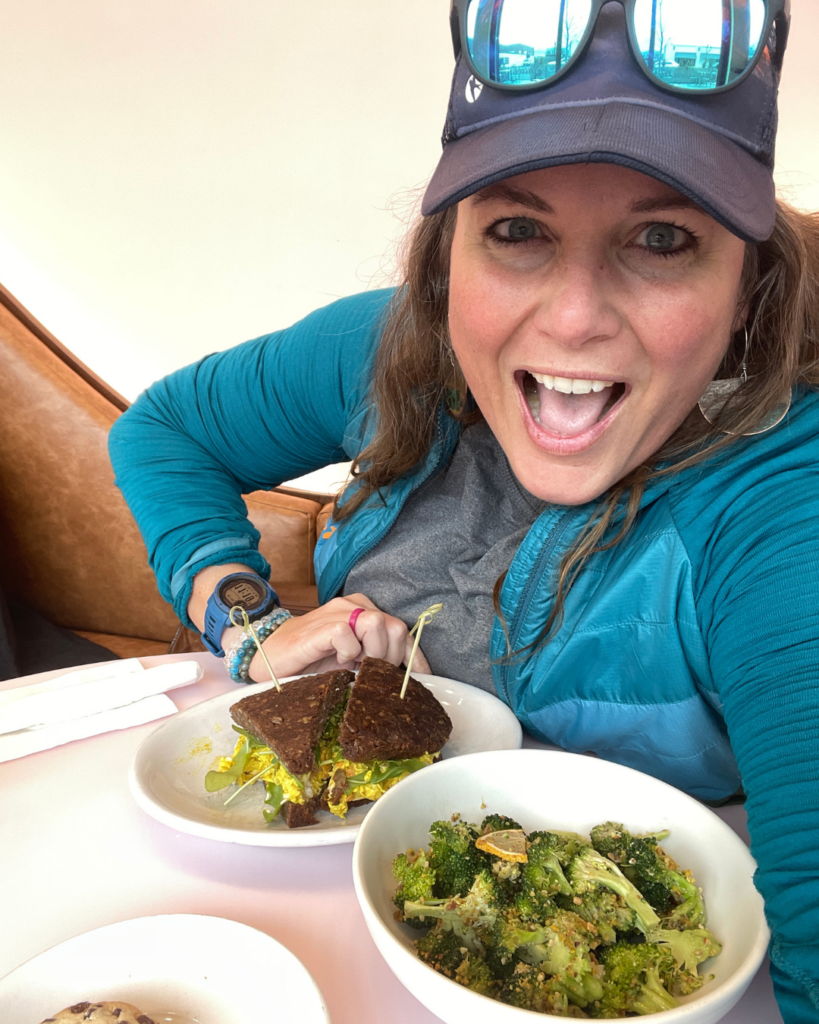
I’m Nichole. I have spent more than ten years living with Celiac Disease and Alpha Gal Syndrome at the same time, which means I have gotten very good at reading menus, asking better questions, and eating extremely well anyway. Alpha Celiac Gal is where I share what actually works. Come find me on Instagram at @alphaceliacgal.